
On the night of 28th February, 2026, Iran’s Supreme Leader Ayatollah Khamenei Martyred in Iran due to the joint military aerial attack of Israel and America. The Iranian leader’s death is a big shock to Iran and its poltical regime.
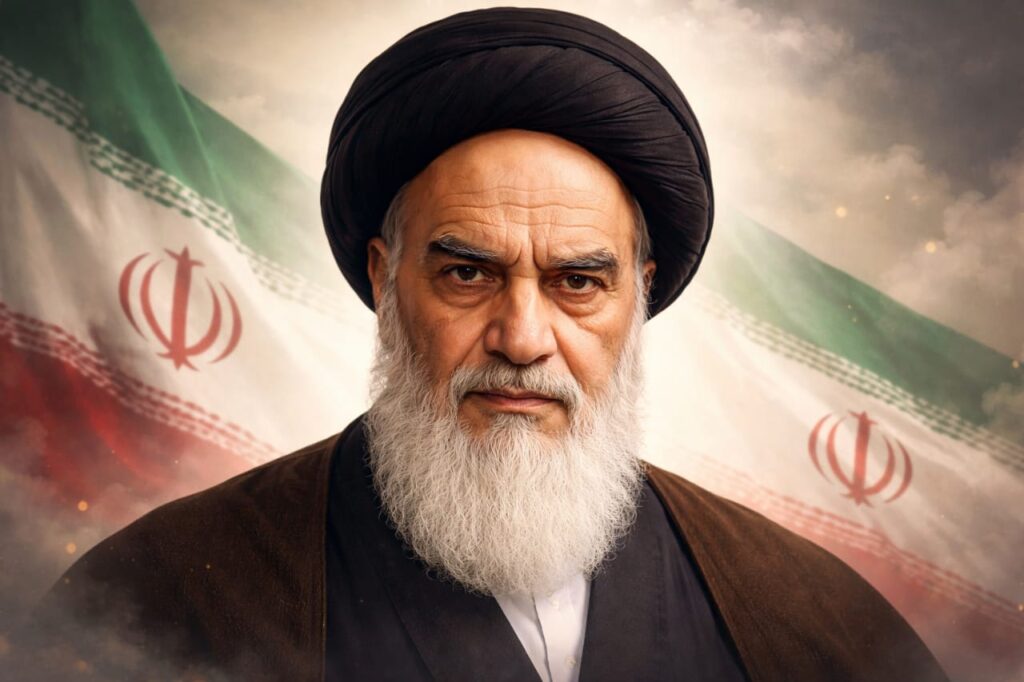
Ayatollah Khomeini’s full name is Sayyid Ali Hosseini Khomeini. He was born on 17th of July 1939 in the holy city of Iran, Mashhad, in a religious family. He has studied Islamic theology and jurisprudence in the sacred city of Qom. Moreover, he was a famous Shia cleric. Furthermore, Ayatollah Khomeini was active political and religious opposition leader in Shah Iran monarchy before the Islamic revolution of Iran in 1979. (Also Read: US Recent Attack)
Ayatollah Khomeini death
on 28th February 2026. On 28th of February 2026, Ayatollah Khomeini was reportedly murdered by the joint Israel and US airstrikes by targeting the key sites in Tehran, Iran. Later on, the Iranian media confirmed Khomeini’s death. In this regard, the Iranian government has declared 40 days of mourning and 7 days of public holidays all over the Iran. In the reaction, the Iranian Armed Forces, including the Islamic Revolutionary Guard Corps, vowed to revenge the death of the Iranian supreme leader. Similarly, Iraq has also announced three days national mourning in response to the death of Iranian supreme leader.(Related: Operation Ghazab Lil-Haq)
Ayatollah Khomeini’s role in 1979 Iranian revolution
Ayatollah Khomeini joined the Islamic movement led by the Ayatollah Ruhullah Khomeini, which had overthrew the US-backed Shah of Iran in 1979. This movement has revolutionized the Iranian culture and political setup, which later on established the Islamic state of Iran.
Moreover, after the revolution, Ayatollah Khomeini held many key positions in Iran, like Iranian parliament member, deputy minister of defence, and Friday prayer leader in Tehran. (Related: Current Affairs Latest Updates)
Similarly, Ayatollah Khomeini has helped the political setup in consolidating the new Islamic Republic.
Ayatollah Khomeini Rise to National Power
Ayatollah Khomeini was become the president of Iran in 1981 to 1989. So after the revolution, Ayatollah Khomeini was the second president of Iran.
Ayatollah Khomeini as Supreme Leader
Ayatollah Khomeini has served as the Iranian supreme leader since 1989 to 2026. He has succeeded the Ayatollah Khomeini after his death in 1989 and become Iran’s highest leader for almost 36 years.
As the Supreme Leader of Iran, Ayatollah Khamenei outranked all the elected institutes, such as Parliament and President. He was a powerful leader in Iran and his supervision was all over the institutions in Iran, like the judiciary, military, intelligence agencies, foreign policy, and state media. (Related: Current Affairs MCQs Preparation)
In fact, he was the most powerful and the top authority in Iran. Moreover, the rule of Khamenei was marked by a suppression of dissent, like crackdowns on students’ protests in 1999, national unrest in 2009, and women’s freedom movement protests starting in 2022 after the death of Mahsa Amini in police custody.
Iran economy and Khamenei’s role
Currently, the economy of Iran is passing through the worst condition of its era. The economy of Iran is badly hit by the US sanctions. These sanctions are Put on Iran due to its nuclear program, as Iran for the last many years is engaged in nuclear program, therefore, America and its allies has put severe sanctions that are led to political and economic sanctions on Iran.
In this way, many states are restricted to trade with Iran and purchase its oil. This resulted in the severe economic crisis in Iran, devaluation of its currency, and low trade volume.
Foreign policy of Iran and Khomeini’s role
The foreign policy of Iran is anti-Western and anti-Israeli. The Khomeini adopted a staunch anti-U.S. and Israeli ideology, commonly calling the U.S. great Satan. In this way, the Iranian supreme leader supported the nuclear program, maintaining it even after the 2015 nuclear deal.
Under the leadership of Khomeini, Iran has established a strong proxy network in the region. Under his leadership, Iran backed militant Shia groups in Lebanon, that is Hezbollah, also in Iraq, Syria, and Yemen.